
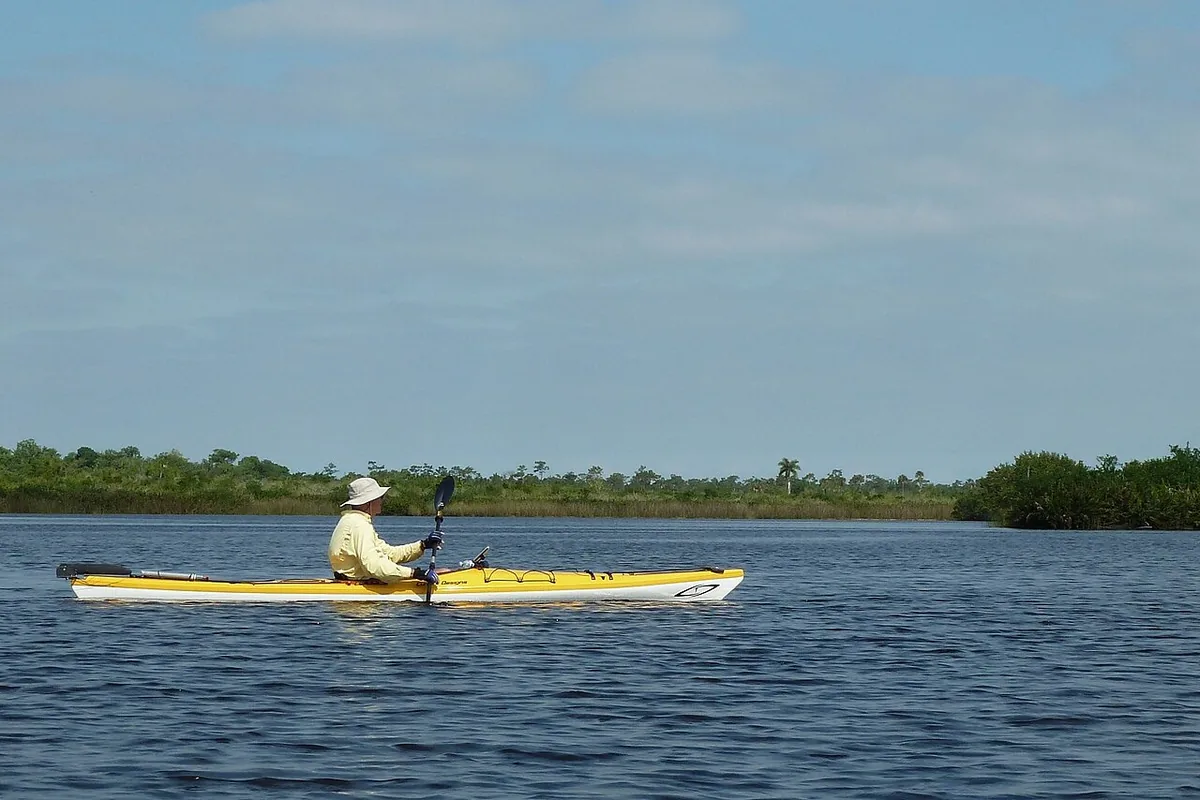
The paddle is the one piece of gear you hold for the entire trip, and a bad one will ruin a good day faster than a bad kayak. Too short and you lean and splash; too long and it feels heavy and clumsy; too heavy and your shoulders give out in an hour. The good news is that a perfectly good beginner paddle costs less than a dinner out.
How paddle length works
Paddle length is set by two things: how wide your kayak is, and how tall you are. The kayak’s width matters more — the paddle has to reach the water past the side of the boat, and a wide recreational kayak pushes your hands further out than a narrow touring boat.
Use this chart as a starting point (low-angle paddling, which is how almost all beginners paddle):
| Paddler height | Boat under 23” wide | Boat 23–28” wide | Boat 28–32” wide | Boat over 32” wide |
|---|---|---|---|---|
| Under 5’ | 210 cm | 220 cm | 230 cm | 240 cm |
| 5’ to 5’6” | 215 cm | 220 cm | 230 cm | 240 cm |
| 5’6” to 6’ | 220 cm | 220 cm | 230 cm | 250 cm |
| Over 6’ | 220 cm | 230 cm | 240 cm | 250 cm |
For a typical recreational kayak 28 to 32 inches wide, most adults land on 220 to 230 cm. If you are between sizes, go shorter — a shorter paddle is easier to control, and a longer one is harder to handle. You can also fine-tune later: if you paddle with a relaxed, low-angle stroke, go 5 cm longer; if you paddle hard and steep, go 5 cm shorter.
One more check: stand the paddle upright next to you with one blade on the ground. The top of the shaft should reach roughly to your chin or the top of your head for a low-angle paddle. It is a rough check, not a rule — the chart above is more reliable.
Shaft materials: what you are paying for
Aluminium. The beginner standard. Cheap (around $40 to $70 for a complete paddle), tough, and heavy — a typical aluminium paddle weighs around 35 to 40 ounces (1,000 to 1,150 g). It gets cold in cold weather and can bend if you lever it hard against a rock, but it is hard to break. Best for: a first paddle, rocky launches, and anyone who is not sure how much they will paddle.
Fibreglass. The mid-range step up. A fibreglass shaft with nylon or fibreglass blades weighs around 28 to 32 ounces and flexes slightly, which is easier on the joints over a long day. Around $100 to $180. Best for: paddlers who go out every weekend and want a lighter paddle without the top price.
Carbon fibre. The lightest option, around 22 to 26 ounces, and the most expensive — $200 to $400 and up. Stiff, efficient, and a real difference on a long trip. But carbon is brittle: it can crack on a hard rock hit where aluminium would just dent. Best for: experienced paddlers who paddle long distances and treat their gear gently.
For a first paddle, aluminium is the right call. The weight difference matters less than people think when your stroke is still developing, and you will not cry if it gets scratched on a launch.
Blade shapes: low-angle vs high-angle
Paddle blades come in two broad shapes. Low-angle blades are long and narrow, made for a relaxed stroke where the paddle stays fairly horizontal — this is how beginners paddle, and how most recreational paddling works. High-angle blades are shorter and wider, made for an aggressive, vertical stroke used in touring and whitewater.
Buy a low-angle blade. A high-angle blade in a beginner’s hands mostly creates splash and shoulder strain. Some paddles are sold as “low-angle” explicitly; if the listing does not say, a long narrow blade is low-angle and a short wide one is high-angle.
Blade material matters too: plastic (polypropylene) blades are tough and cheap and fine for learning. Fibreglass blades are lighter and stiffer, and they hold their shape better. Carbon blades are the lightest and the most fragile. For a first paddle, plastic blades on an aluminium shaft are the standard combination for a reason.
Two-piece vs one-piece
Almost all recreational paddles come apart into two pieces, and you want that. A two-piece paddle fits in a car, stores easily, and lets you adjust the feather angle — the offset between the two blades. Most beginners paddle unfeathered (blades in the same plane, 0 degrees), which is simplest. A feathered paddle (blades offset by 30 to 60 degrees) cuts wind resistance on the recovery stroke, but it twists your wrists and is not worth learning until your basic stroke is solid. Keep it at 0 degrees for your first season.
Drip rings and other details
Drip rings are the small rubber rings on the shaft near the blades. They stop water running down the shaft onto your hands and into your lap. Make sure your paddle has them, and slide them to about a hand’s width above the blade. If your paddle did not come with them, a pair costs a few dollars.
A paddle leash — a cord from the paddle to the boat — is a debated accessory. It stops you losing the paddle in a capsize, but it can also tangle around you in the water. For flat-water beginner paddling, a leash is optional; if you use one, attach it to the boat, not to yourself.
Beginner paddles worth buying
- Carlisle Magic Mystic (around $60 to $80). The classic beginner paddle: aluminium shaft, asymmetrical polypropylene blades, available in 220, 230, and 240 cm. Tough, reliable, and sold everywhere. The default recommendation.
- Bending Branches Whisper (around $70 to $90). Aluminium shaft with a slightly lighter feel and a comfortable grip. A step up in finish from the cheapest paddles without a big price jump.
- Aqua-Bound Sting Ray Carbon (around $150 to $180). A carbon shaft with fibreglass-reinforced nylon blades — noticeably lighter than aluminium, and the usual first upgrade. Buy this one if you already know you will paddle every weekend.
- Werner Skagit FG (around $130 to $160). Fibreglass shaft, mid-size blades, and Werner’s sizing support. A well-made paddle that lasts for years.
Avoid the no-name paddles sold in discount bundles for $20. They are often too short, too heavy, and have ferrules that jam or wobble — and a wobbling ferrule is genuinely dangerous if it comes apart mid-stroke.
When to upgrade
Upgrade your paddle when your stroke is consistent and you are paddling for more than two hours at a time — that is when the weight saving of fibreglass or carbon actually pays off. Before that, spend the money on time on the water and a better life jacket. A $60 paddle in skilled hands will always beat a $300 paddle in unskilled ones.