
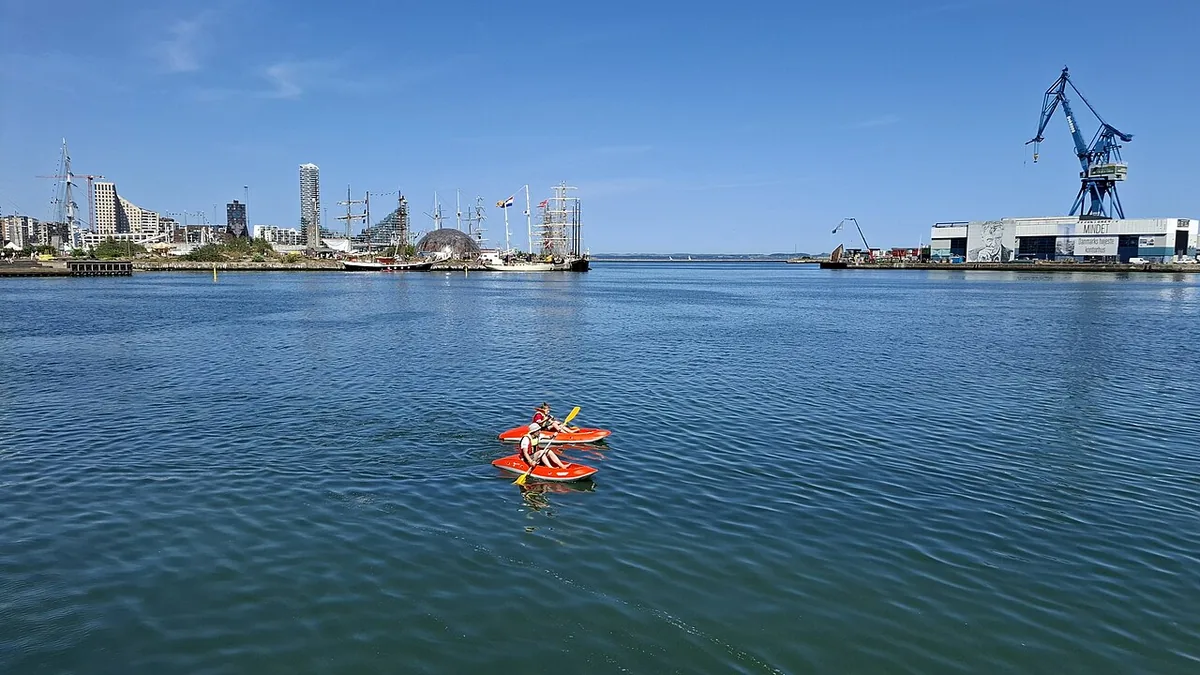
Good paddling is not about arm strength. It is about torso rotation, a clean blade entry, and letting the boat glide between strokes. A beginner who paddles with the torso can go for hours; a beginner who paddles with the arms alone is exhausted in twenty minutes.
Before the strokes, the setup: sit upright with your back against the seat back, knees slightly bent and braced against the inside of the hull or the thigh braces, feet on the foot pegs. Hold the paddle with hands about shoulder-width apart, elbows slightly bent, knuckles up. The grip should be loose — a handshake, not a death grip — so the shaft can rotate in your hands as the blades change angle.
1. The forward stroke — your engine
The forward stroke is 90 percent of your paddling. Get it right and everything else gets easier.
Plant the blade in the water near your toes, fully buried — the whole blade under the surface, not half in and splashing. Pull it back alongside the boat in a straight line, and lift it out at your hip. Do not pull past your hip: the blade behind you pushes water up instead of pushing the boat forward, and it wastes energy.
The power comes from your torso, not your arms. As the right blade goes in, rotate your right shoulder forward and your left shoulder back; as you pull, unwind. Your lower arm pulls, your upper arm pushes forward at about shoulder height, and your hands stay in front of your chest. Think of it as winding and unwinding your core, with the arms mostly transmitting the force.
Cadence matters more than force. Short, steady strokes with a pause for the glide will move the boat faster and straighter than long, hard pulls. Watch the bow: if it swings side to side, your strokes are too long or too hard on one side.
Common mistakes: pulling with the arms only (shoulders burn fast); lifting the blade out behind the hip (wasted effort and splashing); holding the paddle too tight (forearm fatigue); looking down at the blade instead of ahead (the boat follows your eyes).
2. The reverse stroke — your brakes
The reverse stroke is the forward stroke backwards: plant the blade behind your hip, push it forward to your toes, lift out. Use it to stop the boat, back away from a dock or a bank, and slow down before a turn.
It is also your emergency stop. If you are heading for an obstacle, two or three hard reverse strokes will kill most of your speed. Practice stopping from full speed in open water so you know how far the boat travels before it stops — it is further than you think.
Common mistakes: leaning back while reversing (which destabilises the boat — stay upright and let the arms do it); using reverse as your main steering (it is slow and clumsy for turning).
3. The sweep stroke — your steering
A sweep turns the boat. Plant the blade near the bow and sweep it out in a wide arc away from the hull, finishing near the stern. A forward sweep on the right side turns the boat left; a forward sweep on the left turns it right. The wider the arc, the stronger the turn.
To turn in place, combine a forward sweep on one side with a reverse sweep on the other — the boat spins almost on the spot. This is the move for turning around in a narrow creek or getting the bow pointed back toward shore.
Sweeps are also how you correct course in wind. If the wind keeps pushing your bow off to one side, a few sweep strokes on the opposite side will bring it back without stopping your forward motion.
Common mistakes: making the arc too tight (a tight arc is just a bad forward stroke, not a turn); sweeping with the arms while the torso stays still (no power); sweeping on the same side repeatedly (the boat goes in circles).
4. The draw stroke — moving sideways
The draw moves the boat sideways without turning it — useful for sliding up to a dock, a friend’s boat, or a landing spot.
Reach the blade out to the side, about two feet from the hull, plant it vertically, and pull it straight toward the boat. Just before the blade reaches the hull, slice it out of the water by turning the blade parallel to the boat and pushing it back out. Repeat. The boat slides sideways toward the blade.
For a stronger version, the sculling draw: keep the blade in the water and move it back and forth in a small figure-eight, pulling toward the boat on each pass. It is smoother and keeps the boat moving sideways continuously.
Common mistakes: pulling the blade all the way into the hull (it hits the boat and stops you); leaning toward the blade (which tips the boat — keep your weight centred and let the paddle do the work).
5. The low brace — the save
The low brace is the stroke that keeps you upright when the boat tips. When you feel the boat going over to one side, slap the flat of the blade down onto the water on that side, with your elbow low and the blade behind your shoulder, and push down. The blade’s surface area pushes against the water and holds you up while you shift your weight back to centre.
The key detail is keeping your elbow down and your hand below your shoulder. A high brace — elbow up, blade high — puts your shoulder in a vulnerable position and is a common cause of shoulder injuries. The low brace is safer and strong enough for anything a beginner will meet.
Practice the low brace in shallow water on purpose: lean the boat until it feels tippy, brace, recover. Do it on both sides until the motion is automatic. On your first real trip you will use it when a boat wake or a gust catches you by surprise, and by then it needs to be a reflex, not a thought.
Common mistakes: reaching too far out (which pulls you further off balance); bracing with a vertical blade (a vertical blade slices through the water and gives no support — keep it flat); freezing instead of bracing (the boat keeps tipping while you decide).
Putting it together
On a normal lake trip you will use the forward stroke constantly, the sweep every few minutes to adjust course, the reverse at docks and stops, the draw rarely, and the brace only when something surprises you. That is the whole toolkit.
Three drills will build the muscle memory fast:
- The straight line: pick a point on the far shore and paddle to it using only forward strokes, keeping the bow on the point. If you wander, correct with a sweep, not by paddling harder on one side.
- The stop: paddle at normal speed, then stop the boat in as short a distance as you can with reverse strokes. Repeat until the distance is consistent.
- The spin: in open water, spin the boat 360 degrees using sweep strokes only, first one way, then the other. It teaches the sweep arc and how the boat responds.
Ten minutes of drills at the start of each trip will improve your paddling faster than hours of unfocused paddling. And when the strokes start to feel automatic, your attention frees up for the part that actually matters: where you are going, what the water is doing, and how good it feels to glide.